The DTES
Policy Swamp
Scott Gilbert's campaign analysis of why the current DTES policy ecosystem has produced billions in spending, thousands of deaths, and no measurable recovery — and what municipal implementation of the provincial recovery agenda looks like.
Campaign Analysis — Not Legal Findings
The analysis on this page represents Scott Gilbert's campaign critique of public policy — not legal accusations, proven findings of fact, or claims of criminal intent. It is a political argument about which policy choices have produced which outcomes, based on publicly available data. Organizations named here are named because they are the publicly funded institutions responsible for the current status quo. Criticism of outcomes is not a claim of malice.
Billions Spent. Thousands Dead. No Exit.
British Columbia has spent billions of dollars on the Downtown Eastside over the past two decades. The overdose public health emergency has been in force since 2016 — nearly a decade — with annual deaths continuing to climb. In 2023 alone, over 2,500 British Columbians died of drug toxicity. The majority of services in the DTES are oriented around harm reduction: managing use, distributing supplies, responding to overdoses after they happen.
Scott Gilbert's campaign argument is that this orientation — while not without value — has become the dominant response at the expense of the one thing that actually ends overdose deaths: helping people stop using.
No one overdoses from fentanyl they are no longer using.
Real overdose prevention has to include a clear, funded, and immediate pathway out of drug use. Overdose prevention sites manage the overdoses of people who are still using. That is not prevention — it is triage. Triage matters, but it is not a plan.
The campaign's concern — framed as a campaign argument, not a proven fact — is that the current system has become self- reinforcing: it funds the management of drug use, trains workforces to manage drug use, produces research that validates managing drug use, and generates further funding to manage drug use. Meanwhile, walk-in detox, same-day treatment access, recovery employment, and long-term aftercare have remained underfunded, under-built, and harder to access than the services that help people continue using with a slightly lower chance of dying today.
The people in the DTES deserve a system that is trying to get them out of it — not one that is optimized to keep them stable inside it.
Road to Recovery — Now Reach East Hastings
In 2023, the B.C. government released Road to Recovery — a provincial framework that explicitly reorients addiction policy toward treatment, recovery, and long-term outcomes. The province acknowledged that harm reduction alone is not a strategy for ending the crisis, and committed to expanding detox capacity, treatment beds, and recovery housing.
Scott Gilbert's campaign fully aligns with this provincial direction. The Road to Recovery started in Vancouver — and it must now reach East Hastings.
Vancouver City Hall's job is municipal implementation. A provincial framework is only as good as what happens on the ground. The campaign proposes the following concrete additions at the municipal level:
Same-day access to medically supervised detox — no waitlist, no referral required. A person who wants out should be able to start today.
100 days of lawful work after completing detox and a structured recovery program — with a job waiting, not a return to the same street.
Free or subsidized transit access for people in recovery, connecting them to employment, services, and housing across the city.
A practical, dignity-building entry point to employment and independence — part of the wider recovery employment ecosystem.
Street cleaning, sanitation, graffiti removal, peer navigation, food service — paid work tied to neighbourhood improvement, for people who completed the program.
Financial incentives, transit passes, housing priority, and other tangible benefits tied to program completion — not just promises.
Every detox request, every delay, every outcome published publicly. If the system is failing, everyone should be able to see it.
Recovery ends when a person is stable, employed, and housed — not when they leave the detox ward. Structured support through the transition.
The DTES Policy Ecosystem
This campaign-produced graphic maps the institutional connections between the publicly funded organizations operating in the DTES policy space — including health authorities, research bodies, service operators, and supervised consumption providers.
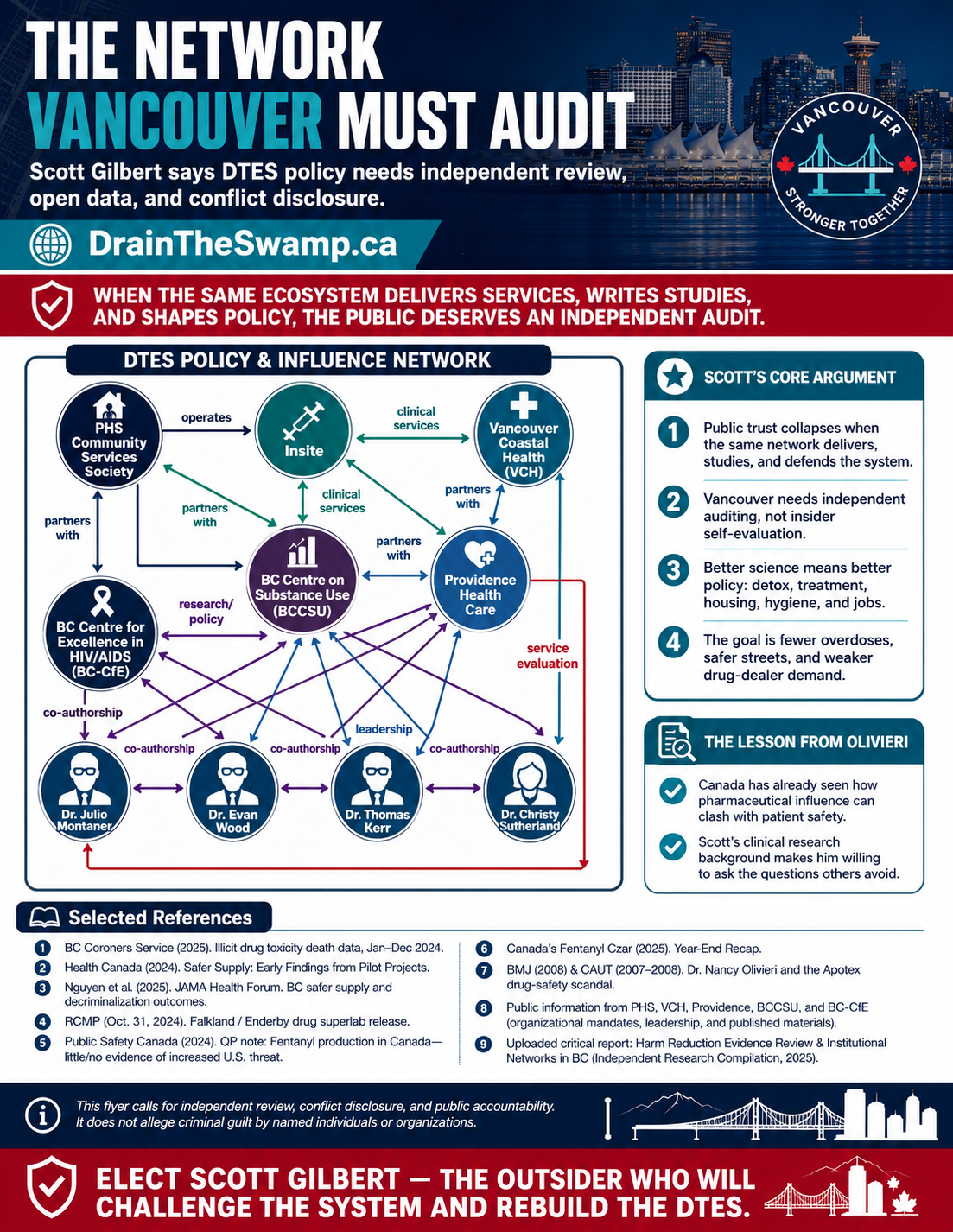
Campaign research graphic. Depicts publicly documented institutional relationships. Not a finding of wrongdoing — a map of who is responsible for the current outcomes.
Organizations in the DTES Policy Ecosystem
These are the publicly funded institutions whose decisions, research, and service models have shaped the status quo in the Downtown Eastside. Naming them is not an accusation — it is a description of where responsibility lies.
The regional health authority responsible for publicly funded addiction and mental health services in the DTES. Funds and oversees much of the service ecosystem in the area.
A major health authority and hospital operator in Vancouver, including St. Paul's Hospital. Involved in addiction medicine and supervised consumption services.
Canada's first government-sanctioned supervised injection site, located on East Hastings. Opened in 2003 under federal exemption. Operates with a harm-reduction model.
A network of lower-oversight supervised consumption facilities, often operated by community organizations with public funding. Multiple OPS sites operate in and near the DTES.
A provincial research and guideline body that produces clinical recommendations on addiction treatment. Influential in shaping safe supply and harm reduction policy.
A longstanding DTES social housing and services organization. Operates several residential hotels and services, and has been involved in supervised consumption and safe supply programs.
A UBC-affiliated research centre originally focused on HIV treatment. Has expanded into addiction research and is associated with early safe supply program design.
Status Quo Terms vs. Plain Language
The language of the DTES policy ecosystem has developed its own vocabulary. This table presents Scott Gilbert's campaign interpretation of what these terms mean in practice — and what clearer framing looks like. Disagreement with this framing is expected and legitimate.
| Term | What It Usually Means in Practice | Scott Gilbert's Framing |
|---|---|---|
| Toxic drug supply | Positions the problem as a supply-quality issue — implying the solution is purity testing or regulation. | Unregulated fentanyl — produced by criminal networks. The drug itself is the problem, not only its purity. |
| Contaminated supply | Euphemism for illicit fentanyl; framing suggests the solution is cleaner drugs rather than stopping use. | Illicit fentanyl supply — the contamination is fentanyl. Purity testing does not eliminate overdose risk. |
| Safe supply | Publicly funded pharmaceutical alternatives to illicit drugs, provided without a recovery requirement. | Subsidized drug provision — does not prevent overdose, does not lead to recovery, and may extend dependency. |
| Overdose prevention site (OPS) | A supervised facility where people use drugs they bring themselves, with staff on hand to respond to overdose. | Supervised use facility — manages overdoses after they occur. Does not prevent use or offer a path out. |
| Supervised consumption | Umbrella term for facilities where illicit drug use occurs under supervision. | Supervised drug use — call it what it is. |
| Supervised injection | Injection-specific version of the above. | Supervised drug injection. |
| Harm reduction | A broad philosophy and practice of reducing negative consequences without requiring abstinence. | Harm management — a useful component of a complete system, not a destination. Without a recovery pathway, it becomes maintenance. |
| Low-barrier care | Services with no conditions of access — no sobriety requirement, no referral needed. | Unconditional access — valuable for engagement, but without any recovery pathway it can reinforce the status quo indefinitely. |
| Complex care | High-acuity services for people with overlapping mental health, addiction, and housing needs. | High-needs care — the term is accurate, but it should not be used to argue that recovery is impossible. |
| Lived experience | Having personal history with addiction, homelessness, or the systems that serve people in crisis. | Personal experience — genuinely valuable, and should include people in long-term recovery, not only current users. |
| Hotspots | Geographic clusters of drug use, overdose, or disorder. | Concentrated use areas — a descriptive term that should trigger intervention, not management-in-place. |
| Safe consumption | Supervised drug use — same as OPS. | Drug use under supervision. |
| Public health emergency | Declared by B.C. in 2016. Has remained in force ever since — now nearly a decade. | Ongoing overdose crisis — declared nearly a decade ago, not resolved. The emergency framing should produce emergency results. |
| Wraparound supports | Comprehensive services addressing housing, mental health, income, and other needs together. | Multi-service support — valuable, but must include detox and recovery as core components, not optional add-ons. |
| Evidence-based | Claims to be grounded in peer-reviewed research; used to end debates rather than continue them. | Research-supported — always ask: evidence of what outcome? Measured over how long? Funded by whom? |
| Trauma-informed | Accounts for trauma history in service design and delivery. | Trauma-aware — important context, not a reason to avoid offering recovery. Trauma-informed care should lead somewhere. |
| Recovery-oriented system of care (ROSC) | A system designed to support long-term recovery across multiple life domains. | Recovery-oriented — the campaign endorses the goal. Vancouver's implementation needs to catch up to the name. |
This table represents campaign analysis and political framing — not clinical definitions, legal findings, or statements of proven fact. It is a deliberate argument about language, accountability, and outcomes.